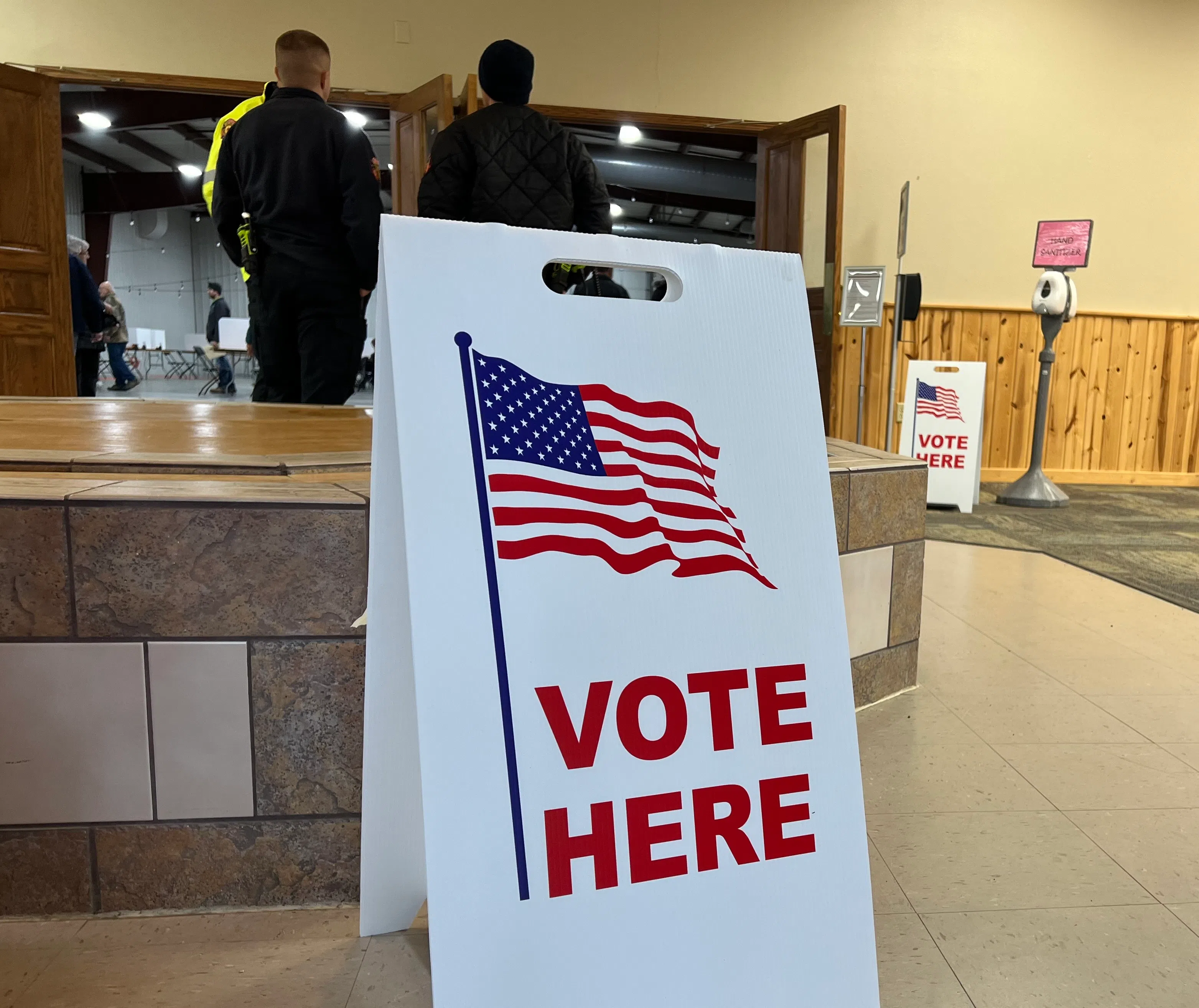
PIERRE, S.D. (South Dakota Searchlight) – Turnout among Republicans in Tuesday’s runoff election fell by about 20,000 voters compared to the June primary — a drop that a University of South Dakota political science professor said was predictable.
Participation fell from 43% in June to 36% Tuesday, driven by low motivation, polling that made the race look like a foregone conclusion and other factors, according to Julia Hellwege.
“It’s about what I’d expect,” she said.
Toby Doeden and Gov. Larry Rhoden made it into the runoff for the Republican nomination for governor by finishing first and second in a four-way June 2 primary election. Nobody in that race reached 35%, which triggered the first use of a 1985 state law requiring a runoff when no candidate meets that threshold in a statewide primary. Rhoden won in the runoff.
Runoff elections typically draw fewer voters than the elections preceding them. Unlike South Dakota primaries (held the first Tuesday in June) or the general election (the first Tuesday in November), runoffs have no well-known date for voters to plan around.
Voters less engaged with politics are more likely to miss runoffs, Hellwege said, both because of limited awareness and because voting itself demands time and effort: researching candidates, finding polling locations and making time to show up.
Turnout among registered Republican voters in the runoff ranged from a low of 9.31% in Oglala Lakota County, which is part of the Pine Ridge Reservation, to a high of 54.58% in Sully County in central South Dakota.
Doeden received 7,282 fewer votes in the runoff than in the June primary. Some of those voters may have backed Rhoden instead, but the majority likely stayed home, Hellwege said.
Motivation also played a role. With Doeden finishing the June primary at 31% and Rhoden at 25%, most voters heading into the runoff were choosing between candidates who weren’t their first pick.
“It’s not quite as motivating to go out and vote for your second choice,” Hellwege said.
Competitive races drive the most engagement, Hellwege said — and June’s four-way primary was the second-highest Republican primary turnout in the past decade. The runoff turned out to be far less competitive.
Pre-runoff polling from Emerson College, commissioned by KELO-TV, showed Rhoden with a wide lead, which may have further dampened turnout.
“When things are unpredictable, it can draw people out,” Hellwege said. “If they see a poll that says it’s skewed they might think, ‘It doesn’t look that competitive so I don’t need to put as much effort into this and vote.’”
Alfred Slaathaug, of rural Brandon, said he voted for Rhoden on Election Day but debated whether he needed to participate because of the poll results.
“But on principle, I decided not to skip it,” Slaathaug said.
Slaathaug was one of thousands of South Dakotans who registered or switched party affiliations ahead of the runoff specifically to participate in it. Slaathaug switched from the Democratic Party and plans to switch back.
Slaathaug’s and other new Republican votes had little effect on the final margin given Rhoden’s wide win — garnering 71% of the vote — but they may have nudged turnout upward, Hellwege noted.
Advance voting — mail-in and in-person ballots cast before Election Day — made up 22% of total runoff turnout, up slightly from the 18% to 19% typical of recent Republican primaries.
Auditors attributed the uptick to party switchers voting immediately after changing their registration. Hellwege said the shift wasn’t dramatic but made sense: Voters registering specifically to support a candidate are more likely to vote early, as are committed partisans who had already made up their minds in June.
“More than likely, early voters were folks who had a clear idea of who they were going to vote for, which makes it easier to submit their ballot ahead of time,” Hellwege said.
The next election will be Nov. 3, when voters will choose between Rhoden and Democratic challenger Dan Ahlers in the race for governor. The general election ballot will also include other statewide and local races and ballot questions.




Comments