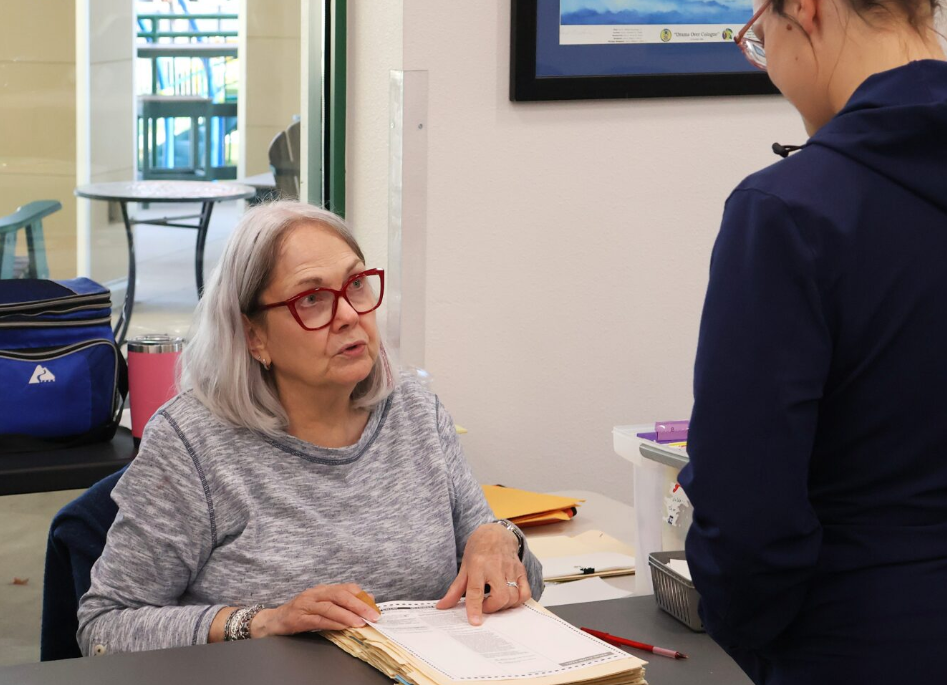
Paulette Neff, an election judge at the Morton Mandan Public Library, talks to a voter about their ballot during early voting on Oct. 28, 2026. (Photo by Michael Achterling/North Dakota Monitor)
BISMARCK, N.D. (North Dakota Monitor) – Election workers are primed for Election Day after nearly a year of training, working primary elections and guiding tens of thousands of North Dakotans through early voting.
“The general public does not realize how many previous months and how many hours the staff puts into getting ready for Election Day,” said Linda Chadduck, a 47-year election worker veteran in Stutsman County.
North Dakota voters on Tuesday will elect their sole member of the U.S. House, choose several statewide office-holders and weigh in on statewide ballot measures related to amending the constitution and providing free school meals.
Chadduck worked Stutsman County’s elections for 37 years until retiring in 2016. Since then, she has worked as a precinct inspector.
The state’s elections have been seamless because of the training provided to the county auditors by the Secretary of State’s Office, she said, who in turn pass that training onto county election officials and poll workers.
“It’s an ongoing thing from the beginning of the year until after the state canvassing board in November,” she said.
Chadduck, who was honored by the secretary of state as the 2026 Election Hero, has at times had to correct false information about the election process.

This year, a friend alerted her to a social media post that incorrectly warned voters not to allow election judges to initial the ballot they receive. Chadduck texted her friend the correct information, that election workers are supposed to initial the ballots.
“It has to have their initials on it,” Chadduck said. “Because if there is a recount, and it’s not initialed, then it does not count.”
Chadduck has also corrected people who incorrectly say that voting machines can be hacked or are connected to the internet.
“No, they are not. They do not even have a place to hook up to the internet in them,” she said.
Educating voters is also an important part of the job for Paulette Neff, an election judge in Morton County, who has worked elections for the past 15 years.
Neff said she likes to go over the ballot with voters before placing it in their hands.
“A lot of people think they have to fill everything out on the ballot, and they don’t have to,” she said. “The big thing is not to have them over vote because then that will kick the ballot out, so I have to tell them that.”
In Richland County, many poll workers have multiple elections under their belts, but this year the county also has some first-time election workers, said Auditor Sandy Fossum.
Fossum, past president of the North Dakota Auditors and Treasurers Association, said she provides additional one-on-one training for poll workers if they have additional questions.
“I try to do whatever it is to make them have a better experience,” she said.
Polls open on Election Day between 7 a.m. and 9 a.m., depending on location. Polls will close at 7 p.m. local time.

No registration is required in North Dakota. Acceptable forms of identification include a North Dakota driver’s license; a nondriver state-issued identification card; a tribal ID or a tribal letter; a certificate from a long-term care facility.
Absentee ballots must be received by 7 p.m. Tuesday. Absentee ballots are not accepted at polling places, but can be dropped off with the county auditor or county dropbox.
Election results will be posted on the Secretary of State’s website beginning at 8 p.m. Central.
Fossum said North Dakotans should keep in mind that polls stay open to allow voters to cast ballots if they are in line by the time the poll closes, which can delay a county’s ability to verify vote totals to be posted on the Secretary of State’s website. She added that some precinct workers need to travel up to 50 minutes to deliver results to the county courthouses.
As of Monday evening, more than 101,000 North Dakotans had cast their ballots early during the 2026 election, according to the Secretary of State’s Office.
More than 242,000 North Dakotans voted during the 2022 midterm election, a nearly 43% turnout.





Comments