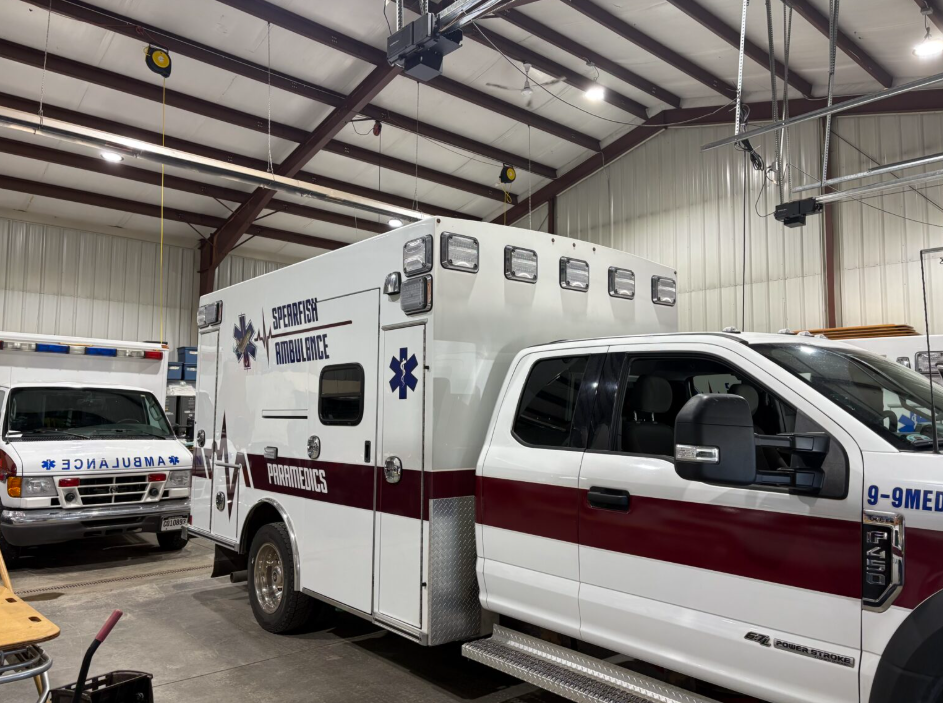
Ambulances are parked in a Spearfish Emergency Ambulance Service facility earlier this year. A task force of South Dakota lawmakers is meeting this summer to discuss ideas for supporting local ambulance service providers. (Photo by Meghan O'Brien/South Dakota Searchlight)
PIERRE, S.D. (South Dakota Searchlight) – Regionalizing ambulance services would preserve them for rural areas and allow the state to guarantee a basic level of coverage, but the state would still need to pick up some of the cost of that guarantee, members of a legislative task force said this week.
What regional service looks like and what the state might have to pay to prop it up are still open questions.
Those were the takeaways from Monday’s meeting of the Emergency Medical Services Funding Task Force in Pierre, where 11 lawmakers gathered for the third of four scheduled meetings. They also concluded that fixing the system will be a multi-year commitment requiring a permanent advisory board.
The task force is the second study group formed in as many years to address ambulance service sustainability in South Dakota in the face of Medicare and Medicaid reimbursements too low to pay for the service, particularly in sparsely populated parts of the state.
Much of the state relies on a dwindling pool of volunteer labor, as well as fewer young people willing or financially able to commit to the hundreds of training hours required for emergency medical technician certification.
In February, lawmakers passed bills to create legal protections for nurses who care for patients in an ambulance and to let police officers and firefighters drive ambulances if local providers deem that necessary. Those bills were recommended by the first task force.
Sen. Tim Reed has chaired both task forces. After Monday’s meeting, which ended with votes creating subcommittees to study regionalization needs and potential revenue models in collaboration with the governor’s office, the Brookings Republican said he sees a path forward during the 2027 legislative session.
The first step will be to create an advisory council of stakeholders in and out of government to oversee the regionalization process.
“We know it’s going to be a big lift to get this done,” Reed said. “So it’s going to take an ongoing group.”
Josie Harms, spokeswoman for Gov. Larry Rhoden, said the governor’s office looks forward to working with the task force “to establish a sustainable EMS system for South Dakota.”
Regionalization remains focus
The work of reforming rural ambulance services got an injection of federal support over the summer.
The state Department of Health signed a contract in August worth up to $719,000 with the South Dakota Foundation for Medical Care for “statewide planning, development, implementation, and oversight of Regional EMS Hub models.” The money comes from a $189 million pool of federal funding awarded to the state for use over the next five years through 2025’s One Big Beautiful Bill Act.
That Rural Health Transformation Program money can’t be used to supplant funding for existing projects, needs a “transformative” element, and must be used for “sustainable” projects, Department of Health Secretary Melissa Magstadt told the task force members on Monday.
“Anything that we bring forward has to come through that sort of lens,” Magstadt said.
Magstadt said her department is prepared to work with lawmakers and an advisory council on other proposals to help shepherd through a regional hub system.
Regionalization should save money through efficiencies, said Rep. Drew Peterson, R-Salem, though it will take time to figure out how much. Even so, he said, the state will need a long-term revenue source to guarantee a minimum level of service.
If the state sets those standards, Peterson said, counties and cities can’t be the ones forced to pay for them.
“I do not want to have an unfunded mandate being sent down to these local governments,” Peterson said.
Ambulance services are funded through a mix of reimbursements for services through private insurance and public insurance like Medicare and Medicaid, limited local government funding in some jurisdictions, fundraising and grant money.
Possible revenue sources
Sen. Ernie Otten, R-Tea, hopes the state can get creative with its federal rural health dollars to ease the transition to a regional model, and that the savings from regionalization make rural ambulance service more affordable.
The committee also discussed more treatment on-site and updating state law to make sure rural ambulance services can bill for doing it, and mandating a certain level of reimbursement from private insurers for out-of-network ambulance services.
Even so, Otten said the task force needs to come to Pierre next year prepared to talk about new income sources to “backfill” gaps that remain after regionalization.
Otten asked the state Department of Tourism to prepare a revenue estimate for a $1 nightly fee on lodging, short-term rentals and campground stays, with the fee applied for up to five nights. Such fees would raise around $7.1 million, according to a document shared at Monday’s task force meeting.
A fee that small wouldn’t be “onerous,” Otten said. Even if people look at their hotel bill and get “a little miffed” about an ambulance fee, Otten said he wouldn’t expect people to balk at paying “a lousy dollar.”
He also mentioned a tax on vapor products like e-cigarettes. Those are taxed at the standard 4.2% state sales tax rate now, but lawmakers passed a bill to license vape retailers this year.
A tax on those products could “easily generate $3 million,” Otten said.
“At the end of the day, we’re going to have to just come to the realization that the state has to pick up a lot of this,” said Otten, who later told South Dakota Searchlight that guaranteeing ambulance service in rural areas is “more than a necessity.”
Other revenue sources
Rep. John Hughes said the state needs to be willing to engage with the state’s three major healthcare systems — Sanford, Avera and Monument — on financial support.
“I can’t think of any entities with more of a vested interest in this,” said Hughes, who argued that supporting ambulance services would be a better use of revenue for the systems than “building another building” or marketing.
“That would be improving the human condition, in my opinion,” said Hughes, referencing marketing language used by Sanford Health.
Hughes had similar comments at a previous task force meeting, prompting an appearance on Monday from Tim Rave, the president and CEO of the South Dakota Association of Healthcare Organizations. In remarks prepared as a response to Hughes’ August remarks, Rave told the task force that hospital revenues in much of the state are razor thin, that hospitals already cover millions in charity care, and that many of the patients transported by ambulances struggle to pay their bills.
Subsidizing ambulance services with hospital dollars would ultimately hurt patient care, Rave said.
“Hospitals are not an unlimited piggy bank,” Rave said.
Hughes said he doesn’t want a mandate, but rather “a conversation” about the role health systems might play in making sure people who fall ill or experience an emergency in a far-flung area can get help in time.
Hospitals already offer some support for emergency medical services in parts of the state, said Rep. Nick Fosness, R-Britton. Fosness is a healthcare administrator, and said one healthcare system in his district pays nurses double their hourly rate to ride along on ambulance calls when the ambulance operator doesn’t have an available volunteer with advanced lifesaving skills. That same system “does the laundry” for the ambulance service, helps recruit new EMS volunteers and offers training.
Such steps are “just a necessity” to serve patients in some places, Fosness said.
“It’s a practical thing, to keep the service and to keep patient safety number one,” he said. “That’s what we all are doing across this great state, trying to keep patients safe and move the right patient to the right services.”




Comments