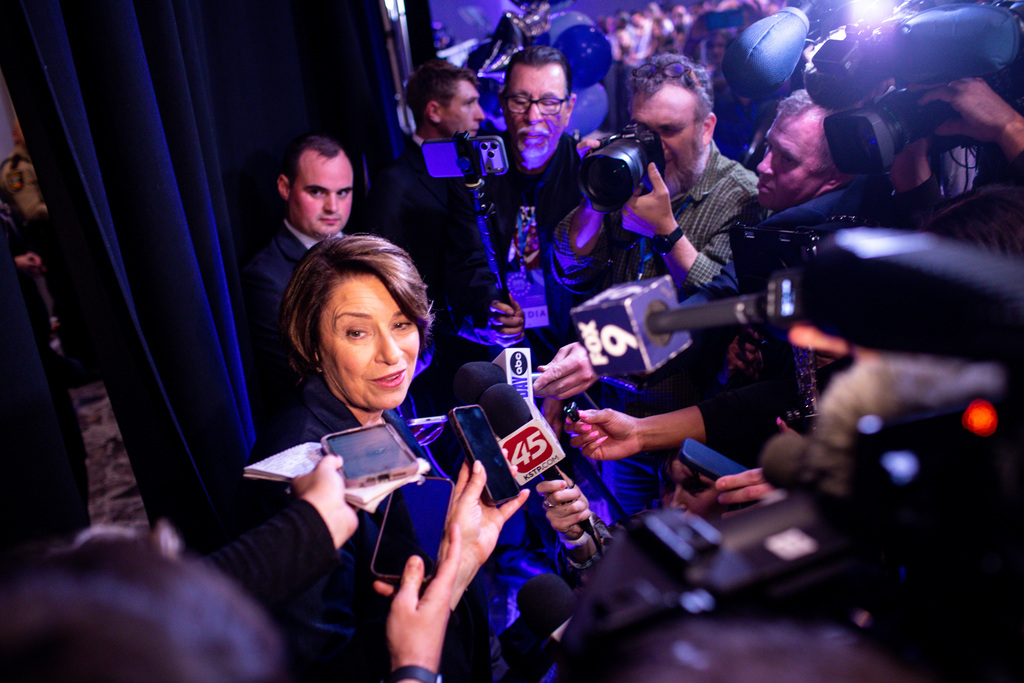
Sen. Amy Klobuchar spoke to reporters at the Democratic-Farmer-Labor’s watch party before the governor’s race was called on Nov. 3, 2026. (Photo by Nicole Neri/Minnesota Reformer)
ST. PAUL, MN (Minnesota Reformer) – Amy Jean Klobuchar became the first woman elected Hennepin County attorney in 1998, the first woman U.S. senator from Minnesota in 2006, and on Tuesday she became the first woman to be elected Minnesota’s governor.
Klobuchar, 66, prevailed over Republican House Speaker Lisa Demuth as Democrats secured the Democratic-Farmer-Labor Party’s hold on the governor’s office for a fifth consecutive term.
As a U.S. senator for 20 years, a 2020 presidential candidate and now Minnesota’s next governor, Klobuchar has cemented her place as one of the most-talked-about and written-about Minnesotans in state history. Her name has become practically synonymous with Minnesota itself, and now, having broken the glass ceiling of Minnesota politics, she enters the history books. The Associated Press called the race for Klobuchar late Tuesday.
“I am going to be a governor, not just for the people that voted for me, but for all of Minnesota. When I said that I do not like the status quo, I meant it. We have a lot of work to do, and it’ll start tomorrow,” Klobuchar told reporters before the race was called.
Klobuchar’s homecoming and historic win should give her a considerable honeymoon with Minnesotans, but she’s also got a major to-do list. She inherits protracted challenges once she takes office in January — a test of the political prowess she’s become famous for over nearly three decades in public office.
The aftermath of the rampant fraud in Minnesota’s social safety net programs continues — authorities executed search warrants on several early autism treatment providers just days ago. Klobuchar has promised to audit state government as soon as she takes office. Student test scores released last month were again stagnant. Younger Minnesotans cannot afford starter homes. The state’s population is barely growing, and the Trump administration’s immigration crackdown has stymied a key influx of workers in important industries like agriculture and construction.
Klobuchar will need to appoint a cabinet and staff her administration. Then she has until the third Tuesday in February to craft a two-year budget and submit it to the Legislature, according to state statute. That’s about 15 weeks from her election win. Minnesota’s spending is rising faster than revenue, creating a structural imbalance beginning in July.
The state still has a massive rainy day fund, but rising healthcare costs, cuts from the federal government and slow economic growth could push the Legislature to dip into the funds.
Klobuchar has said she will not raise taxes.
Demuth, whose rapid rise to House speaker and Republican gubernatorial candidate has now stalled, gave up her seat in the Legislature to run for governor.
Amy to the rescue
Klobuchar rescued Minnesota Democrats from potential disaster by jumping into the governor’s race in January at the behest of DFL Gov. Tim Walz, who dropped his third-term bid amid increasing scrutiny on fraud in Minnesota’s social safety net programs.
Republicans ran on the fraud scandal — the Trump administration’s stated rationale for sending thousands of immigration officials to the state during Operation Metro Surge — and made it their top issue, arguing it was a failure of Democratic governance.
Democrats had worried for months that Walz’s name at the top of the ticket would hand Republicans the governorship for the first time in 16 years and sink Democrats’ prospects down the ballot.
But Klobuchar — Minnesota’s most accomplished vote-getter and fundraiser — gave the DFL, with an assist from President Donald Trump’s sagging approval ratings, fresh energy.
Klobuchar early on in her campaign distanced herself from Walz, promising to get rid of the fraud, create a “growth agenda” for the state and build back trust in the government.
“I’m going to clean up this mess,” Klobuchar said in one of her latest ads.
Steeped in politics
Klobuchar grew up in Plymouth. Her father was a Star Tribune columnist and her mother an elementary school teacher. She was schooled in politics thanks to her father’s work, and went on to graduate from Yale and the University of Chicago Law School.
She worked in the private sector for over a decade, carving a niche for herself at a major Minneapolis firm working in telecommunications law. Klobuchar served as the Hennepin County attorney for eight years, where she was known as a tough-on-crime prosecutor.
In the Senate, Klobuchar has mastered popular issues and has often built relationships with Republicans. During her first year in office, she worked quickly after the deadly I-35W bridge collapse in 2007 to secure federal funding for a replacement. She helped make America’s pool drains safer for children, expanded broadband access and worked on numerous farm bills.
The senior senator is known as policy wonk who works long into the night poring over details. This got her into trouble during her presidential run, as reports of her tyrannical behavior toward her staff leaked. Her demanding boss persona is now well-known, and during her campaign, Klobuchar made the argument that Minnesota needs a hands-on governor who will get the details right.
Staffing a government
Klobuchar will be in charge of 50,000 state employees, and she has said she wants to start fresh with new staff, presumably ditching Walz’s personnel.
“Who you bring in matters, people with management experience. And especially when you’re trying to change a culture in a workplace and have people reporting to you more about things and coming forward with what the problems are. That’s going to be very important to me,” Klobuchar told WCCO radio Monday.
Klobuchar’s transition will have $162,000, according to state statute, with which to staff a transition team, rent out office space and recruit new employees.
Alongside the budget, a key task will be to hire new commissioners, poring over resumes and conducting thorough interviews and background checks. Walz during his transition launched a website through which people could submit applications for open positions, and his team worked out of the Capitol’s third floor.
Part of Klobuchar’s transition will be to turn the promises she made during the campaign into real policy. Klobuchar promised to help the construction industry build 100,000 new housing units, ban cell phones from schools, create a state tax credit if Congress fails to pass health insurance subsidies and streamline permitting processes that companies say slows the pace of construction.
Regarding Klobuchar’s U.S. Senate seat, if she resigns before her inauguration, Walz would appoint her successor. But Walz can and most likely would defer to Klobuchar, who would then appoint her own successor. Some potential appointees include Secretary of State Steve Simon and U.S. Rep. Kelly Morrison.





Comments