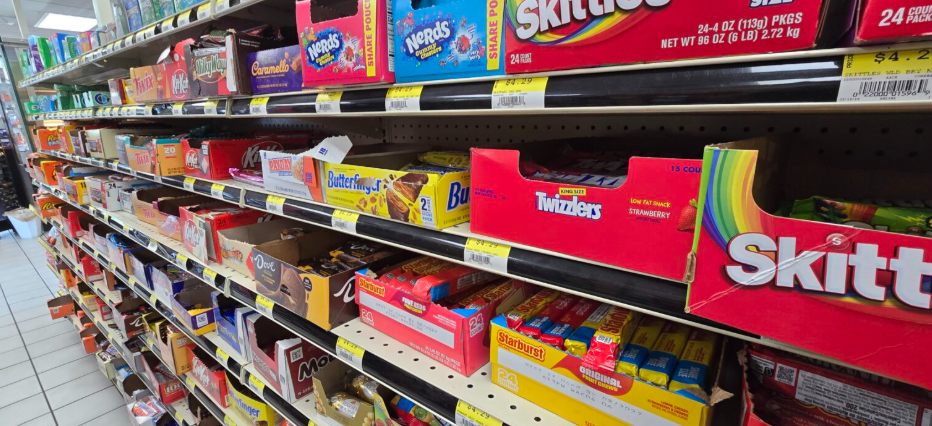
Candy sits on the shelves at a retail store in Bismarck on Aug. 27, 2026. (Photo by Michael Achterling/North Dakota Monitor)
BISMARCK, N.D. (North Dakota Monitor) – The public can now comment on planned changes to what North Dakotans can purchase with federal food assistance after the state postponed implementation of its Healthy Choice Waiver.
The public comment period opened Sept. 15 and will be open until Oct. 15. Comments can be submitted through the Federal Register website.
The waiver, which the state applied for in 2025, would bar North Dakotans from using their Supplemental Nutrition Assistance Program benefits to purchase most candies, energy drinks and sweetened beverages.
The waiver was expected to take effect Sept. 1, but was postponed to Nov. 1 at the request of federal officials in an Aug. 25 letter asking for additional time to post a public notice about the waiver and assess public comments.
The request was likely connected to a recent federal court case challenging the waivers of five other states, said Rebecca Askins, director of the Economic Assistance section of the North Dakota Department of Health and Human Services.
“Part of that suit … is, in essence, requiring that this waiver is going to go through this process in the Federal Register,” Askins said.
The public notice allows anyone, including stakeholders and members of the public, to share their thoughts on the waiver. The notice says the Food and Nutrition Administration, which oversees SNAP, is “particularly interested in comments regarding the state’s implementation and operation of the demonstration project.”
But Askins said she doesn’t know whether those comments could then be used to change North Dakota’s program, given that the state has already spent time and resources preparing to implement the waiver in its current form, which was approved by the USDA at the end of 2025.
“At this stage, it’s too early to know whether those comments would result in changes to North Dakota’s current waiver structure,” Askins said.
Four comments have been submitted as of Thursday. Of those comments, which do not include names, one was in favor and three were against the waiver.
“This is a great first step in cleaning up the unhealthy choices, we as a culture have enabled. Public funding assistance shouldn’t enable these bad habits,” one commenter wrote.
But other commenters said they had concerns about the policy and its impact.
“I have diabetes, and I have personally experienced episodes of low blood sugar (hypoglycemia). When blood sugar drops, a person may need a fast-acting source of carbohydrate immediately,” the commenter wrote. “For a SNAP recipient who has very little cash outside of SNAP, having more than one practical option available matters.”
What does this mean for retailers?
A spokesperson from the U.S. Department of Agriculture told the Monitor that despite the delay, there will still be a 90-day grace period beginning Nov. 1. During that grace period, retailers will not face disciplinary action for failing to update their systems.
Askins said that even if the deadline hadn’t been postponed, the department was “fairly confident” that within the 90-day period, most or all retailers were going to be in compliance with the new rules.
John Dyste, president of the North Dakota Grocers Association, said he’s hopeful that retailers will be able to make the needed changes before the deadline. But he said it’s been a struggle for many grocers and other retailers thus far.
“For the retailers to implement this program is not a simple process. It’s very involved. You’re taking whole categories of food that have been considered SNAP-eligible, and now, all of a sudden, they’re not,” he said.
He added that the changes aren’t always intuitive.
“An example I was given was marshmallows. Mini marshmallows are eligible, but large marshmallows and colored marshmallows are not eligible,” he said.
To help retailers sort through their products, the state paid a research firm to create a list of items that would no longer be eligible for SNAP.
Dyste said his members have told him that the list includes barcodes for around 23,000 items, but many of them don’t match retailers’ codes for the same products. The list also doesn’t include products from grocers’ house brands.
That means that even with the list, retailers are still tasked with making sense of the new restrictions and how they apply to their products.
So far, 106 retailers have requested the list, according to Askins, who said that accounts for about 65% of SNAP retailers in the state. She said the list is only available to retailers upon request because some of its content is confidential.
Some grocers who have reached out to the state for guidance haven’t received much help, Dyste said.
“My understanding is (that) when they contact the SNAP program, basically, what they’re told is that ‘You have to figure it out on your own.’ The recommendation is to go to your POS (point-of-sale) provider,” he said, adding that the service comes at a cost.
HHS hosted a series of webinars over the summer to explain the changes to retailers. At one of the webinars, an attendee asked whether there would be financial support to help stores pay to update their systems.
An official initially said that the department was pursuing funding for that purpose, but another official cut in to say that, given the then-approaching Sept. 1 deadline, grocers should not count on additional funding.
In the Aug. 27 news release announcing the postponement, Askins wrote that, “The new timeframe also allows HHS to expand support for this initiative.” But she told the Monitor that support does not include financial aid for retailers.
The department is exploring the possibility of doing more webinars between now and November, Askins said, adding that she doesn’t expect additional webinars or any other changes to increase the cost of implementing the waiver, which was initially projected to be $3.5 million to $4 million.




Comments